Download Wireless Communications and Networking By Jon W. Mark, Weihua Zhuang
Connected to this scenario, you can actually have the moment to take Wireless Communications And Networking By Jon W. Mark, Weihua Zhuang as so as feasible. Be among the fantastic people who take this book also for resource. For guaranteeing you to obtain this book, we will certainly demonstrate how you could locate and get the soft documents of it right here. Just adhere to the web link that we offer as well as you can directly find and make deal to get this book. This is just chosen to get as well as wait in some gadget that you bring almost everywhere or in the house or office.
Wireless Communications and Networking By Jon W. Mark, Weihua Zhuang

Download Wireless Communications and Networking By Jon W. Mark, Weihua Zhuang
Dear visitors, when you are searching the brand-new book collection to read this day, Wireless Communications And Networking By Jon W. Mark, Weihua Zhuang can be your referred publication. Yeah, even several publications are supplied, this publication can steal the visitor heart so much. The content as well as motif of this publication truly will touch your heart. You could discover an increasing number of experience and also knowledge exactly how the life is gone through.
When you now feel bemused to try the particular publications to review, Wireless Communications And Networking By Jon W. Mark, Weihua Zhuang can be a choice. This is a clever choice for you. Well, guide could lead you to earn better choices and also options. After getting guide, you will not be bemused once more to locate the appropriate publication. Publication is just one of the home windows that open up the globe. This book is likewise exactly what you need in order to accompany you.
The simple language to recognize, the choice of words, and how the author clarifies the meaning and also lesson of this publication can be stimulated quickly. It means that any kind of individuals from every states and levels can comprehend exactly what this publication will excite. Remarkable and also understanding are two type of joined methods to find out about a publication. When this Wireless Communications And Networking By Jon W. Mark, Weihua Zhuang is presented and used in the public, many people are directly trying to get this book as their own reading product.
Curious? Certainly, this is why, we suppose you to click the link page to go to, and after that you could enjoy the book Wireless Communications And Networking By Jon W. Mark, Weihua Zhuang downloaded and install up until completed. You could conserve the soft documents of this Wireless Communications And Networking By Jon W. Mark, Weihua Zhuang in your gadget. Obviously, you will bring the gadget almost everywhere, will not you? This is why, whenever you have spare time, every single time you can delight in reading by soft copy publication Wireless Communications And Networking By Jon W. Mark, Weihua Zhuang
- Sales Rank: #2406455 in Books
- Published on: 2002-09-28
- Original language: English
- Number of items: 1
- Dimensions: 9.56" h x .87" w x 7.00" l,
- Binding: Paperback
- 368 pages
From the Back Cover
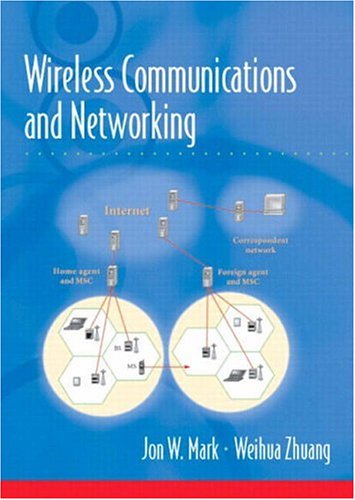
Wireless Communications and Networking covers a wide range of topics from the physical layer to the networking layers of a hybrid wireless/wireline information transport platform. This book meets the need for a relatively short, yet complete and self-contained text suitable for a single-semester senior undergraduate or first-year graduate course. The coverage of internetworking between wireless and wireline networks is unique to this book. The fundamental aspects of mobile cellular communications and networking (signal design, channel characterization, receiver structure, multiple access technologies, mobile cellular networking, capacity enlargement, mobility management, wireless/wireline interworking) are interweaved into a unified and systematic presentation, with illustrative examples throughout the book.
Salient Features:
• Characterization of the wireless propagation channel
• Bandpass signaling for mobile radio
• Receiver design for fading dispersive channels
• Capacity enlargement of cellular systems
• Multiple access techniques
• Mobility management in mobile cellular networks
• Wireless/internet interworking
Excerpt. © Reprinted by permission. All rights reserved.
Signal propagation through a guided wire (e.g., a coaxial cable or an optical fiber) is relatively free of interference. With a wireless channel, the impairments are much more severe. A signal propagating through the wireless channel will be subject to additive background noise, and will experience signal fading, multipath spread, cochannel interference, adjacent channel interference, etc. However, a wireless system has the flexibility to support user roaming, while a wired system lacks this flexibility. Because of its ability to support user mobility, the wireless system has emerged as the key information transport platform to meet the demands of modern society. However, wireless systems suffer a number of shortcomings, the most important being the severe channel impairments that limit the usable spectral width. Also, a wireless system has either a limited geographical coverage (e.g., ground radio) or a long propagation delay (e.g., geostationary satellite). Wireless cellular communication based on radio propagation has been evolving from narrowband (i.e., the first generation (1G) and second generation (2G) wireless systems) to wideband (i.e., the third generation (3G) wireless systems). With their geographical coverage limitation, wireless systems need a backbone network to extend their geographical coverage to enable global communications. A wireline network such as the Internet has universal appeal. The interworking of a wireless network as the front-end and the Internet as the backbone has been receiving much attention in recent years. With a hybrid wireless/Internet network, the wireless front-end supports user roaming while the Internet backbone offers global coverage.
The severe impairments in the wireless channel introduce a set of challenging problems for the network provider. When the demand for system bandwidth is not very high, the problems of spectral limitation and transmission errors associated with conventional modulation and coding methods may not be so intolerable. This is the case with narrowband cellular communications Systems (e.g., 1G and 2G). To support multimedia communications (e.g., in 3G) mitigation of channel dispersive fading and multiple access interference effects are critically important.
The present text is aimed at providing the fundamentals of wireless communications and networking to senior undergraduate students. The materials in the text have been given as a one-semester course to fourth year students several times at the University of Waterloo. The student who takes this course would have in prior semesters already had courses in the principles of analog and digital communications, probability theory, and signal analysis methods.
The book begins with an overview of wireless communications and networking by providing a road map on these topics. The salient features of first and second generation wireless cellular systems, and those perceived for the third generation wireless systems, are highlighted in this overview. The focus of the text is on fundamentals at the senior undergraduate level. The materials on wireless communications and networking are organized into seven chapters, Chapters 2 through 8. Chapter 2 aims at providing an informative exposition and an understanding of the characteristics of the wireless channel, which form the basis for the development of bandpass transmission techniques in Chapter 3 and reception techniques in Chapter 4. These three chapters focus on the properties of the physical transmission layer, with the objective of providing an understanding of the characteristics of the various types of interference and the methods used at both the transmitter and receiver for mitigating these types of interference.
The fundamentals of cellular communications, including the rationales for cellular systems and the properties of frequency reuse to enlarge system capacity, are described and discussed in Chapter 5. One of the main benefits from wireless cellular communications is the ability to support multiple users who are on the move. Simultaneous transmissions by multiple users can lead to conflict, resulting in destructive interference. Techniques to resolve conflicts, and hence permit multiple access of the common resources, are described and the ramifications are discussed in Chapter 6.
Although wireless systems offer the flexibility for users to roam, user mobility nevertheless creates a set of challenging problems for the network provider. Mobility management that takes care of handoff and locating the whereabouts of the mobile unit to facilitate information delivery are discussed in Chapter 7. On the other hand, the geographical coverage of a wireless system is limited. Global communications that permit anyone to communicate from anywhere at anytime require global geographical coverage. The Internet is the most pervasive global network that has been enjoying universal acceptance. The ramifications of, and the interworking of, a wireless front-end and an Internet-Protocol-based backbone as the global communications platform for supporting user mobility are described and discussed in Chapter 8.
Solutions to selected end of chapter problems are available to instructors who have adopted the text for classroom use in academic institutions. They can be obtained by contacting the publisher. Also available from the publisher is set of MATLAB® simulations that may be used with various exercises throughout the book. The simulations have a user-friendly interface and were created using MATLAB version 6.0. They can be used for demos in the classroom.
Societal demand for services from anywhere at anytime will likely escalate with time. It is hoped that the fundamentals of wireless communications and networking presented in this text provide the right foundation and appetite for individuals graduating from the bachelor degree program in engineering to pursue further learning in the area.
We would like to thank Ka Chun (Kyle) Chan for the development of the simulation programs. We would also like to thank Professor Vijay Bhargava and the anonymous reviewers for the valuable comments on, and suggestions for improving, the flow of the manuscript.
JON W. MARK AND WEIHUA ZHUANG
Waterloo, Ontario
Wireless Communications and Networking
By Jon W. Mark, Weihua Zhuang PDF
Wireless Communications and Networking
By Jon W. Mark, Weihua Zhuang EPub
Wireless Communications and Networking
By Jon W. Mark, Weihua Zhuang Doc
Wireless Communications and Networking
By Jon W. Mark, Weihua Zhuang iBooks
Wireless Communications and Networking
By Jon W. Mark, Weihua Zhuang rtf
Wireless Communications and Networking
By Jon W. Mark, Weihua Zhuang Mobipocket
Wireless Communications and Networking
By Jon W. Mark, Weihua Zhuang Kindle